Pedro Tamburro is a product designer & design engineer crafting digital products end to end.
●Rio de Janeiro, BR
●Your time
Pedro Tamburro is a product designer & design engineer crafting digital products end to end.
Product Design & Full-Stack | Produto próprio
Year
Role
Duration
Team
Tools
View Project
A Duolingo for professions: you test your knowledge of UX, front-end, or marketing in five-minute daily challenges, see your real level per competency on a visual map, and come back every day to raise it. Immediate feedback, real gamification (XP, streak, achievements, leaderboard), and 100% free — no paywall, no daily limit.
People studying or already working in a profession don't know how much they truly master it. Forty-hour courses die at module two, certificates attest to attendance rather than competence, and most learning products hide the most useful content behind a paywall. What's missing is a fast, honest, and free way to answer one simple question: where are my gaps? The design challenge was to turn self-assessment into something people would want to do every day, without the fatigue of video lessons or the guilt of yet another idle subscription on the card.
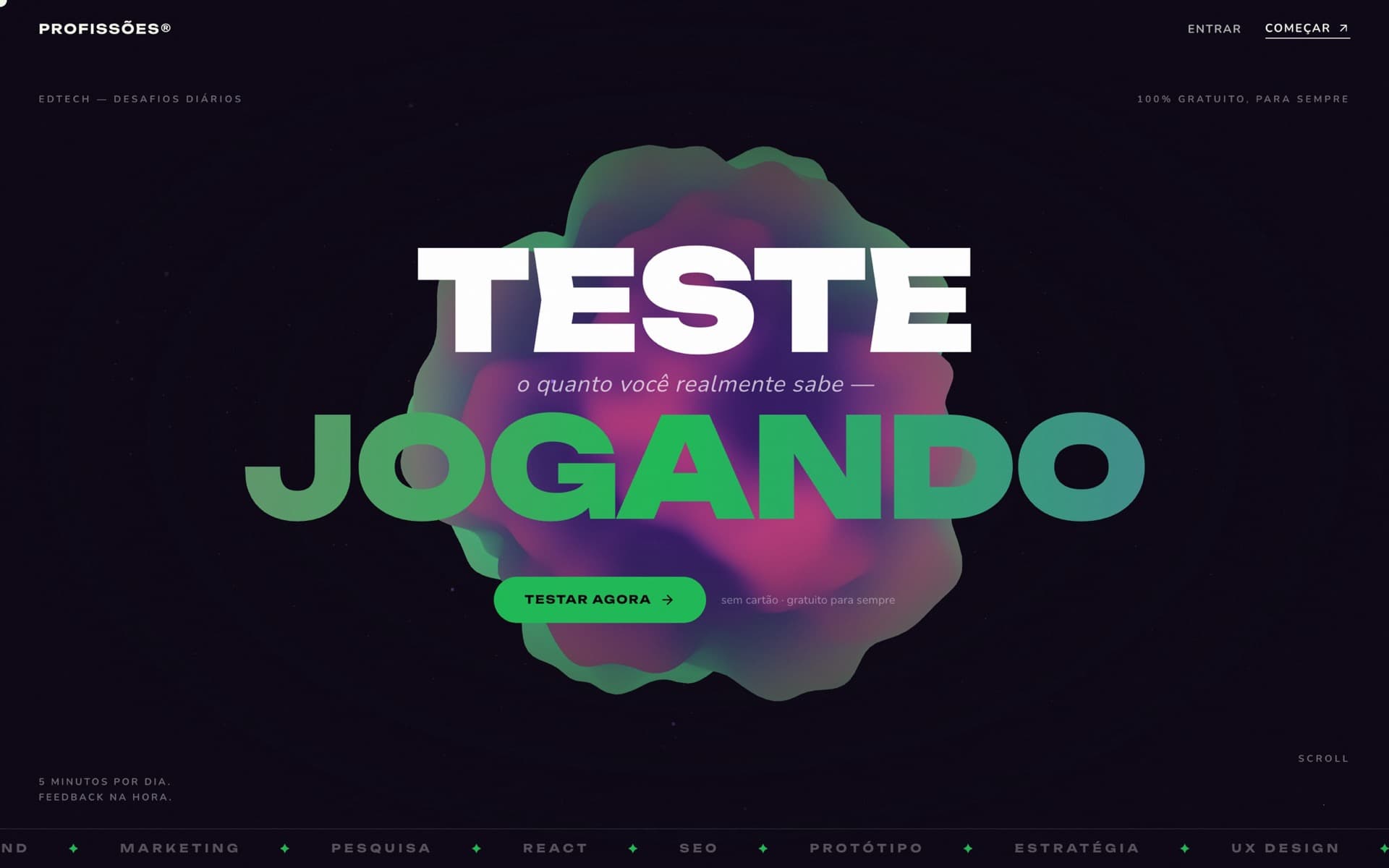
Dark landing with a WebGL orb (Three.js) and GSAP-animated display typography
Duolingo proved that the daily streak and immediate feedback are more addictive than any long course, but it treats language as a linear track. For a profession, competence isn't linear: someone can nail UI and struggle with research. The direction was a competency map (not a track), where each skill has a 0-to-100 mastery bar that is itself the measure of how much you know. Making everything free was deliberate: knowledge shouldn't have a turnstile, and retention would come from habit and visible progress, not from a gate.
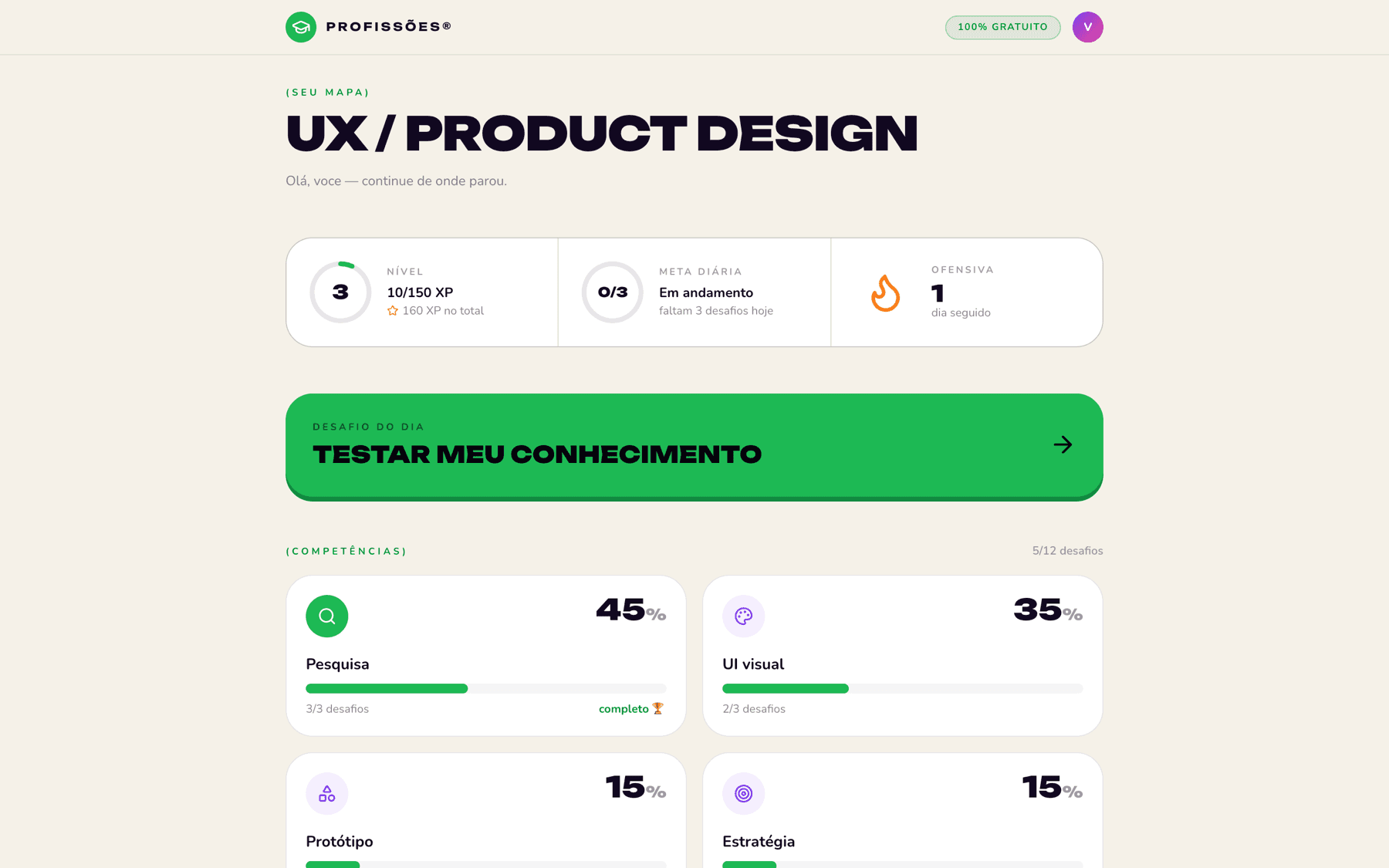
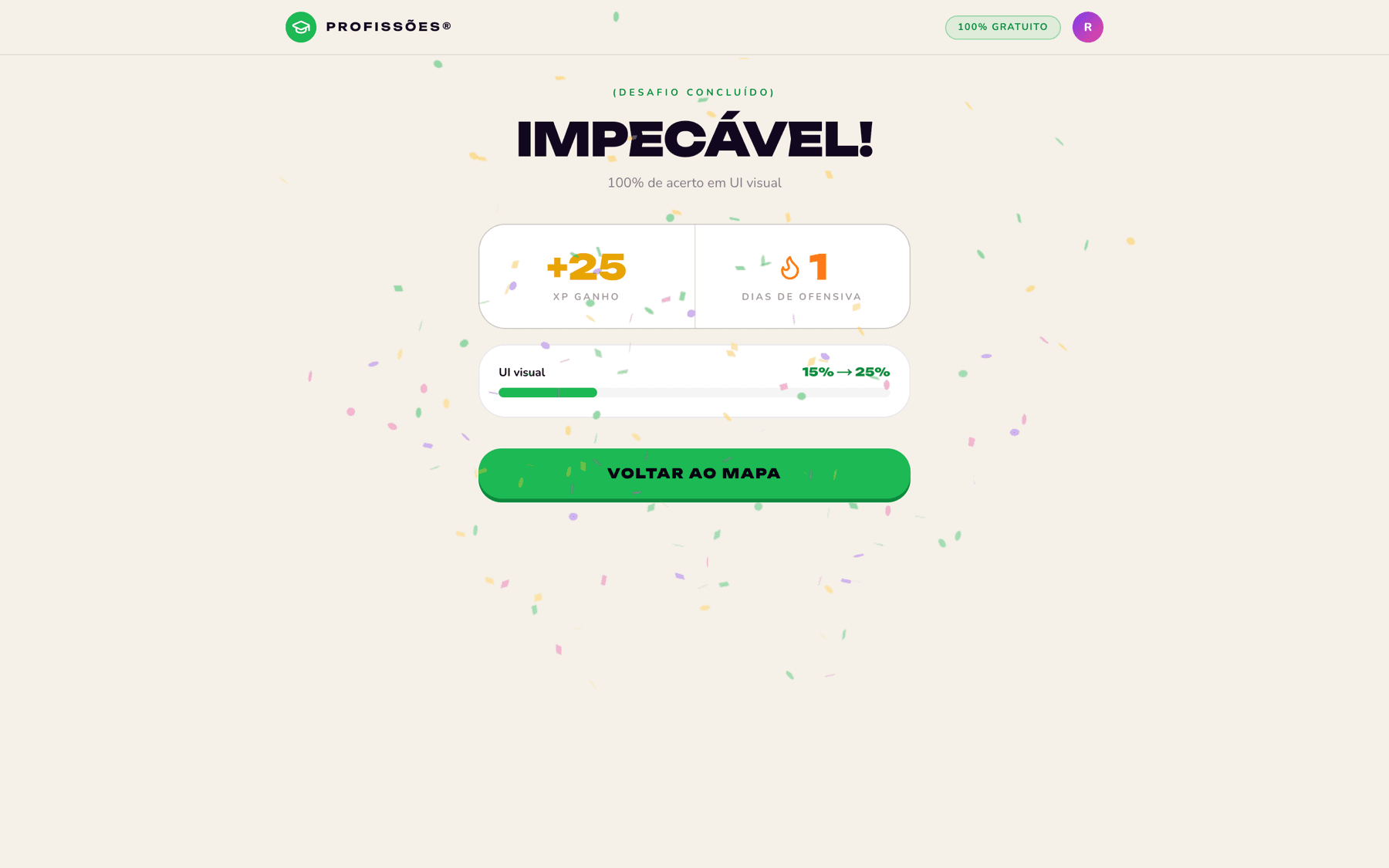
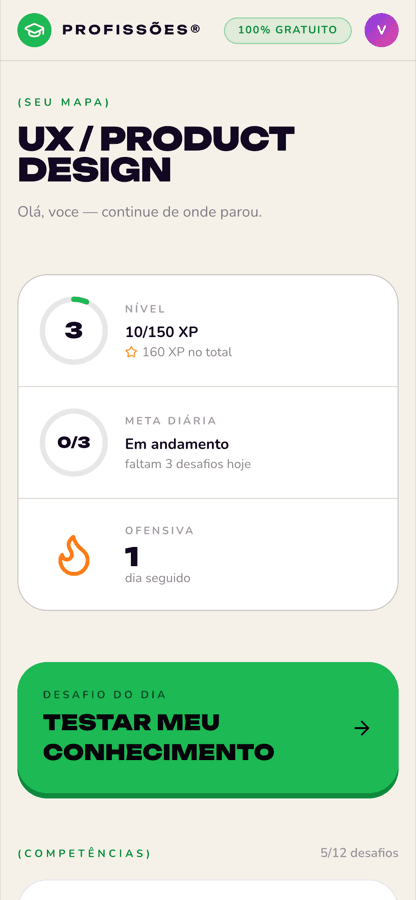
Profissões delivers a short daily loop: the map shows your competencies with a mastery bar, streak, and XP; you pick a skill, take a five-minute challenge, and get feedback on the spot with every answer; on completion, you watch XP add up, mastery rise, and the streak advance. Onboarding is a light self-assessment that positions each skill's starting point, so no one begins from absolute zero. The whole app UI adopts an editorial paper direction (cream background, Unbounded display type, hairlines, and green micro-labels), a deliberate contrast to the dark, kinetic landing.
Editorial paper dashboard: level, daily goal, streak, and per-competency mastery
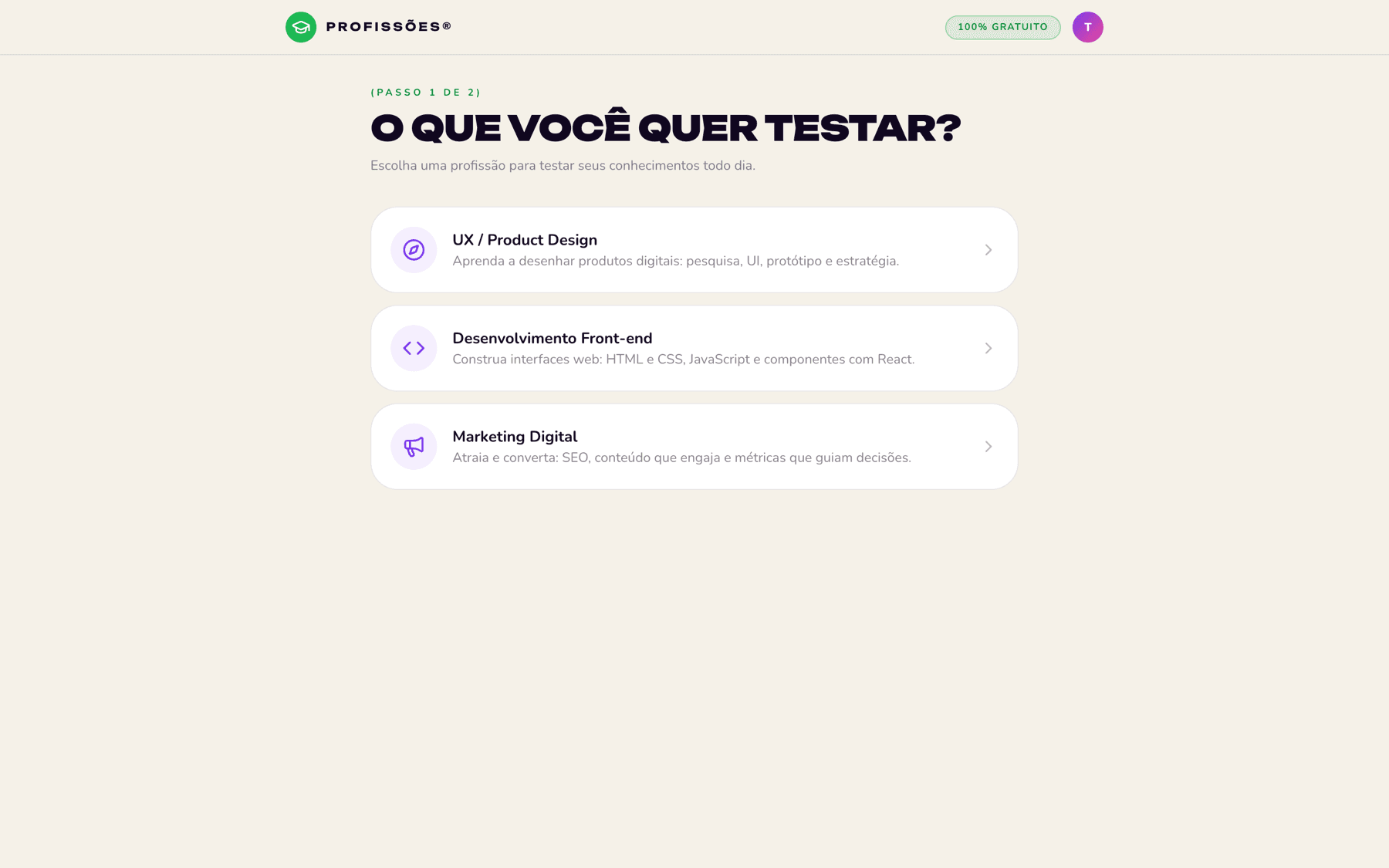
Self-assessment positions each skill's initial mastery on the map
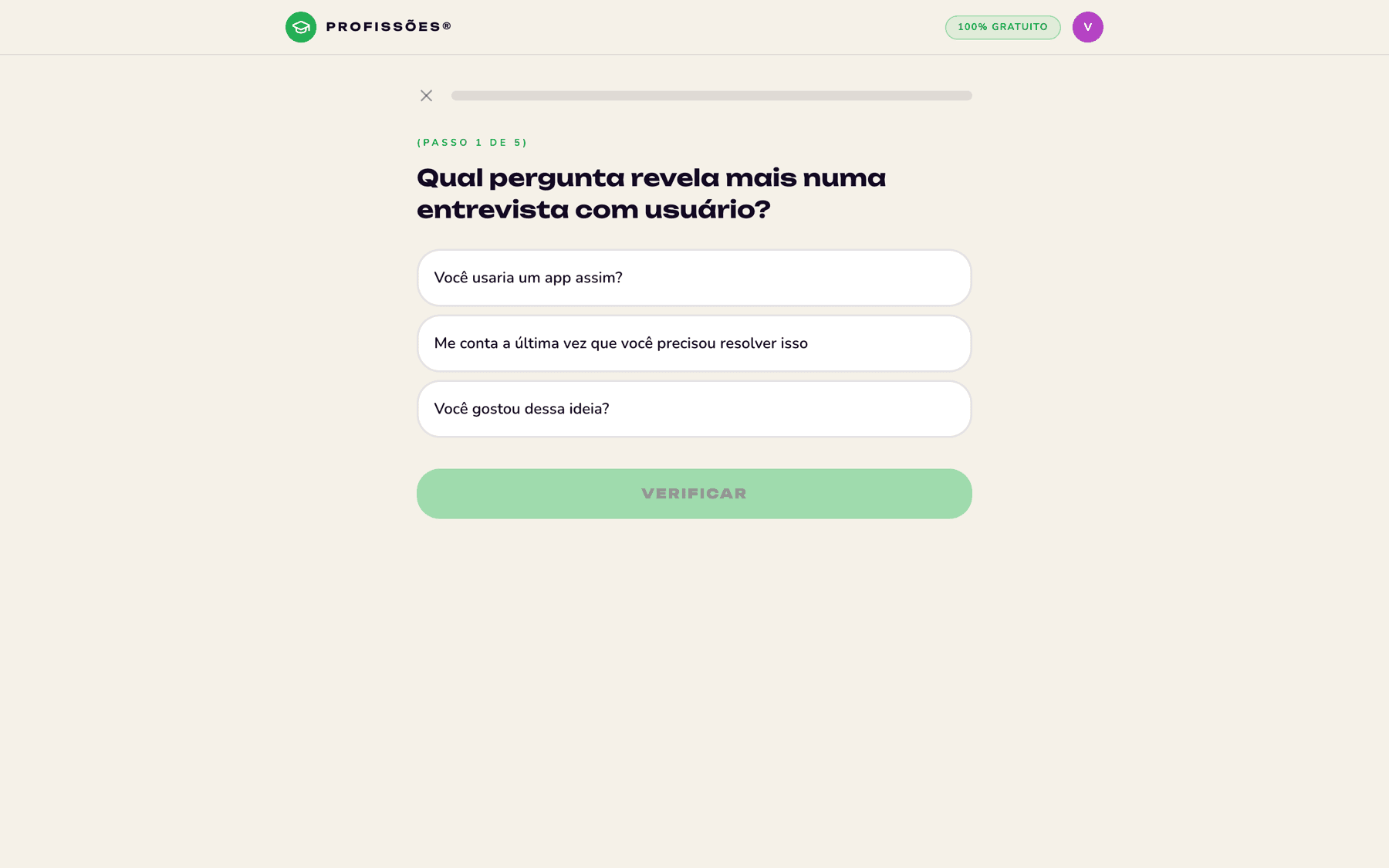
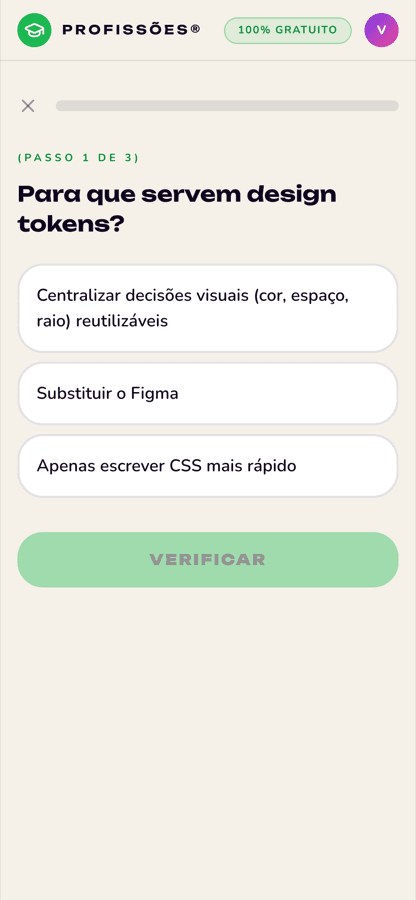
Each format tests a different kind of knowledge and keeps the pace varied across a challenge's steps. Evaluation is immediate and client-side (the correct answer ships in the step payload), while XP, mastery, and streak are applied on the server upon completion. A combo of consecutive correct answers delivers that extra dopamine push. There are 3 professions, 10 competencies, and 30 challenges across three levels (beginner, intermediate, and advanced).
Built with AI coding (Claude as pair programmer, from shaping to deployment). Stack: Next.js 16 (App Router, Turbopack), Prisma + PostgreSQL (Neon) for professions, skills, challenges, and progress, Auth.js v5 for login, TanStack Query on the client, Three.js and GSAP on the landing. The product grew out of a shaping process (requirements, breadboard, and vertical slices) documented in the repo, and went through a major pivot: it started freemium with Stripe and became 100% free, which required ripping out the paywall, the daily limit, and the plan enum without breaking the core loop. Continuous deployment on Vercel, with a demo mode that opens the whole app via guest login.
The core learning was that the product doesn't sell content, it sells self-knowledge with a habit. The most important decision was to measure mastery per competency on a map, instead of stacking lessons on a track, and to let gamification (streak, combo, achievements) carry retention. The pivot to free reinforced the proposition: without the friction of a paywall, the only reason to return is progress itself, which raised the bar for feedback and reward design. Technically, separating immediate client-side evaluation from server-side XP application kept feedback instant without giving up a trustworthy scoreboard.